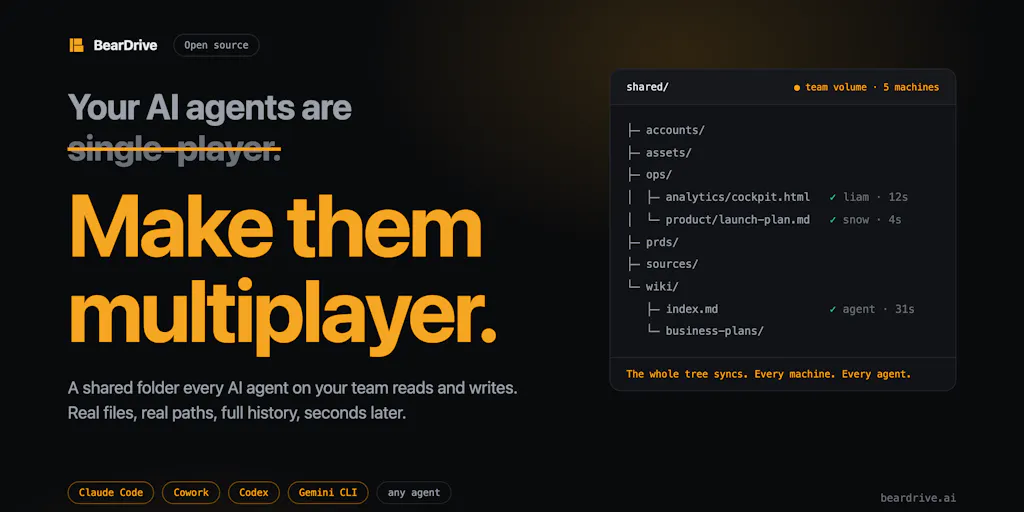
Most AI agents work in silos, writing files to local folders that nobody else can see. BearDrive syncs these folders so your agents can actually collaborate by reading and writing to the same local paths in real time.
🎯
Why It Matters
As we move from chatting with bots to running agentic workflows, the bottleneck is no longer just reasoning, it is data handoff. Builders need a way for Agent A's output to become Agent B's input without manual uploads or human intervention.
📈
Market Impact
This shifts the focus from centralized cloud storage like Google Drive toward decentralized, agent-accessible local file structures. It targets the specialized developer and power-user segment using CLI-based agents.
🚀
Opportunities
→Build agentic assembly lines where specialized agents, such as a researcher and a technical writer, pass files through a BearDrive-synced directory.
→Integrate BearDrive into local dev environments to automate the handoff between automated testing agents and documentation agents.
→Develop agent-first storage solutions that prioritize machine-readable, high-speed sync protocols over human-centric UIs.
⚠️
Risks & Challenges
→Security vulnerabilities arise if agents have write access to shared local paths that are not properly sandboxed, potentially exposing sensitive system files.
→Low defensibility exists because major IDEs or operating systems could bake local-path syncing directly into their native agent integrations.
Deep Intelligence Analysis
The Context Bottleneck
The real friction in agentic workflows is not the model's reasoning, it is the data handoff. If an agent produces a CSV, a human usually has to move it to where the next person or agent can use it. BearDrive treats the file system as a live, shared communication channel.
Moving Beyond the Chatbox
We are seeing a pivot from Chat-as-the-Interface to File-as-the-Interface. High-end AI work happens in the terminal and local directories, not in a web UI. BearDrive bets that the next generation of collaboration happens in the background, not in a Slack thread.
Signal vs. Noise
In a market where integration often beats model quality, BearDrive's success depends on becoming a frictionless part of the developer's stack. If it remains a niche utility, it will be a footnote. If it becomes a standard for local agent coordination, it is a massive win.
What to Watch
Watch for how it handles high-frequency writes from multiple agents simultaneously. If it can manage versioning without breaking local dev environments, it has real legs. Track whether major CLI-based agent tools start mentioning BearDrive in their integration docs.
Key Details
Stop treating agent outputs as isolated files and start treating them as shared state within a synchronized directory.
The winners in the agent space won't just be the smartest models, but the ones that fit easiest into existing local workflows.
Keep an eye on whether OS-level players or major IDEs try to swallow this functionality into their native agent ecosystems.